Raleigh tile mostly fights two things: red clay that finds its way indoors and humid summers that keep showers damp. Scale from hard water is a smaller worry here than in many cities. This guide walks through what darkens grout in Raleigh homes and which service, cleaning, sealing or color sealing, fixes each problem.
Red clay and the back door
The soil survey maps clay loam as the top soil layer at the center of ZIP 27601, with a drainage class of well drained. Anyone who gardens in clay knows the color it leaves behind. Clay loam sticks to boots and paws when wet and turns to rust-colored dust when dry.
Either way it gets into grout. Wet clay smears into the joints like paint, and the iron in red soil can tint light grout orange or brown. Dry clay dust works into the lines with every footstep. The grout inside the back door, the garage entry and the mudroom is usually the first to change color.
Clay stain is stubborn because it binds to the cement, so ordinary mopping only dilutes it and spreads it to the neighboring joints. A professional clean uses a cleaner that releases the soil, brushes every joint and extracts the rinse water so the tint leaves with it instead of soaking back in.
When clay has stained grout for years, cleaning may lighten it a lot without bringing it all the way back. That is where color sealing helps: a tinted sealant goes into every joint and covers what is left, so the entry matches the rest of the floor again and stays sealed against the next muddy season.
Between visits, a coarse mat outside each door and an absorbent one inside catch most of the clay. Dry sweeping before mopping keeps the dust from turning into a slurry in the joints. A sealed entry turns most clay tracks into something a damp cloth can wipe up.
Soft water, and why showers still go gray
Raleigh Water reports hardness of 25.2 ppm on average, ranging from 21.9 to 35.3 ppm as calcium carbonate, which is soft water. That means very little of the white crust that builds up in hard-water cities, and glass doors stay clearer between cleanings.
Showers in soft-water homes still darken, just for different reasons. Soap rinses away less completely in soft water and leaves a slick film. Body oils, conditioner and shampoo dyes collect in it, and the grout takes on a gray or yellow cast, darkest at the bottom of the walls and around the drain.
The crew aims the clean at that film rather than at minerals: an alkaline cleaner for ceramic and porcelain, a stone-safe product for marble or travertine, firm brushing of each joint and a hot rinse with extraction. A clear sealer afterwards keeps the next round of soap on the surface.
Pink or orange rings at the drain and along the lowest grout lines are common in soft-water showers. They are usually airborne bacteria living on soap residue in damp spots, not rust. They clean out easily, and a dry, sealed shower gives them much less to live on.
Humid summers, mild winters
The NOAA normals station at Raleigh State Univ, NC, about 4 miles away, records 49.4 inches of precipitation a year, 4.5 inches of snow and 57 days with a low of 32 F or colder. The median last spring freeze is March 28 and the median first fall freeze is November 8.
That means a long, warm, damp season. Bathrooms dry slowly in humid air, and grout that stays wet for hours a day is where mildew takes hold, first in corners and along the curb, then up the walls. Cleaning lifts the staining from the grout surface.
Keeping it away is mostly airflow. Run the bathroom fan during the shower and for twenty minutes after, leave the door and the curtain open, and squeegee the walls. If mildew comes back within days of a clean, or grout feels soft, water may be getting behind the tile, and the crew will recommend regrouting.
Spring pollen adds its own layer. A yellow film settles on everything outdoors and blows in through doors and screens, and on a damp shower floor or a freshly mopped kitchen it sticks to the grout and tints it. A rinse of the shower walls and a dry dust mop on the floors through pollen season keep it from setting in.
Newer homes across a growing city
The Census Bureau counts 224,853 housing units in Raleigh, and the median year homes in Raleigh were built is 1997. Detached single-family houses are 44 percent of homes. Downtown leans newer still: in ZIP 27601 the median year homes were built is 2005, and 32 percent are detached houses.
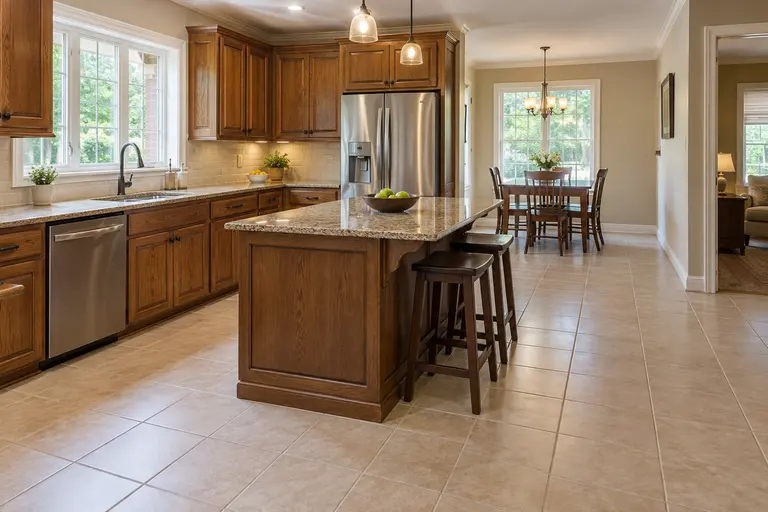
Homes from that period often have tile in the kitchen, the laundry and every bathroom, frequently with builder-grade cement grout that was never sealed. After ten or twenty years of mopping, that grout has absorbed a lot. Traffic lanes in the kitchen and the hall bath floor are usually the darkest spots.
A whole-floor clean brings those lanes back toward the color of the protected edges. Sealing then keeps them there. If you plan to sell, a clean plus color sealing in the kitchen and baths is one of the most visible updates you can make in a single day without replacing anything.
Townhomes and condos downtown are often newer, with large porcelain and narrow joints. Building rules about parking and work hours go in the quote notes. The crew's extraction equipment keeps rinse water off the floor, which matters when there is a unit below.
Stone, porcelain and everyday care
If any of your tile is natural stone, such as marble, travertine, limestone or slate, choose natural stone in the quote form. Acids etch calcium-based stone, so vinegar and many bathroom sprays leave dull marks on it. The crew uses pH-neutral, stone-safe products and tests a small area first.
For every kind of tile, the routine that keeps grout clean longest is the same: dry sweep or vacuum, then mop with a pH-neutral cleaner, and change the water as soon as it looks cloudy. Skip bleach on colored grout, because it lightens some joints more than others and leaves the floor patchy.
Kitchen backsplashes are worth adding to a floor job. Grease from the stove settles on the grout behind it and turns it amber over time. It is a small area that takes little extra time, and clean, light grout there makes the whole kitchen look brighter.