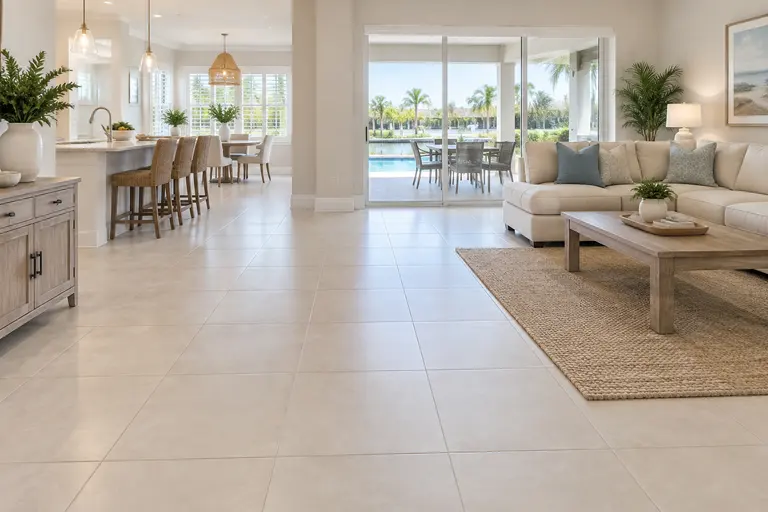
San Antonio water is some of the hardest you will meet anywhere, and it shows on tile. White crust on shower grout, cloudy glass and dull joints along the kitchen floor are the usual complaints. This guide explains why it happens in San Antonio, what a professional clean changes, and how sealing keeps the result from fading in a few weeks.
Fifteen to twenty grains: living with very hard water
The San Antonio Water System (SAWS) gives the hardness of its water as 15 to 20 gpg (grains per gallon), about 257 to 342 mg/L as calcium carbonate. That is in the very hard class. Every gallon that dries on tile leaves a measurable amount of calcium and magnesium behind.
Grout collects those minerals faster than tile does. A glazed tile face is sealed by its glaze, so scale sits on top and wipes off. Grout is open cement. Water soaks in, evaporates, and leaves the minerals inside the joint, where they harden into a chalky layer that brushing alone barely touches.
Many homeowners reach for vinegar or an acid descaler at that point. On glazed ceramic that works for a while, but acid also attacks cement grout and slowly opens it up, so the next round of scale goes in deeper. On marble, travertine or limestone it causes etching that does not come back.
Our crews take the scale and soap film out with cleaners chosen for the tile type, agitate each joint and rinse with extraction. Then we recommend sealing every shower we clean in San Antonio. Sealed grout stops drinking the hard water, and the minerals that do land stay on the surface where a squeegee clears them.
Glass shower doors are a good early warning. When the glass starts to look cloudy a few weeks after cleaning, the same minerals are settling into the grout on the walls and the floor. That is usually the moment to book, before the scale has a chance to harden into the joints and darken the soap film trapped under it.
Clay underfoot
The soil survey maps clay as the top soil layer at the center of ZIP 78201, with a drainage class of moderately well drained. Clay is sticky when it is wet and powdery when it dries. Either way it ends up on shoes, paws and wheels, and from there on the tile inside the door.
Wet clay smears into grout lines like paint. Dry clay dust settles into the joints and turns them a dull tan that ordinary mopping spreads around. The darkest grout in most homes is in the first steps inside the back door and the garage entry, where that traffic is heaviest.
A deep clean lifts the clay back out. Where the entry grout stays a shade darker than the rest of the floor, color sealing evens it out. Mats inside and outside each door and a dry sweep before mopping keep the problem from coming back as fast.
Grease makes clay worse in kitchens. A thin film of cooking oil on the floor turns dust into a sticky paste that clings to the joints, which is why the grout in front of the stove and the sink is often the darkest in the house. The crew pre-treats grease spots so the brushes reach the cement under the film.
Older neighborhoods, newer suburbs
The Census Bureau counts 612,901 housing units in San Antonio. Detached single-family houses are 59 percent of them, and the median year homes in San Antonio were built is 1985. The range runs from early twentieth century houses near the center to large newer subdivisions on the edges of the city.
The main ZIP, 78201, leans older: the median year homes there were built is 1952, and 62 percent are detached houses. Homes from that era often have original small-tile bathrooms with wide grout joints, sometimes in colored tile, plus later kitchen and entry tile added during remodels.
Original bathroom grout from that period can be very hard and dense, or it can be worn soft after decades of scrubbing. The crew checks it before starting. Sound grout cleans up well and takes color sealing nicely. Crumbling grout needs regrouting, which we quote from your photos, and the crew will say so rather than clean over it.
Newer suburban homes tend to have large porcelain tile laid across most of the ground floor. Those floors have fewer joints, but long traffic lanes, and the lanes show first. A whole-floor clean followed by sealing keeps the color even from the front door to the back.
Heat, storms and the occasional freeze
The NOAA normals station San Antonio Incarnate Word, TX, about 4 miles away, records 34.0 inches of precipitation a year and 22 days a year when the low reaches 32 F or colder. Rain tends to arrive in heavy bursts between long dry, hot stretches.
That pattern matters for outdoor tile. Patios, porches and pool surrounds bake in the sun, get soaked in a storm, and now and then freeze overnight. Grout outdoors tends to erode and crack more than it stains. Joints that have washed out need regrouting before any sealer will do much good.
Indoors, the long hot season means air conditioning runs for months and bathrooms dry reasonably well. Where they do not, usually in windowless baths without a working fan, mildew starts in the corners. Cleaning removes the staining from the grout, and a running fan keeps it from coming back.
Dry stretches bring dust instead of mud. Fine dust settles on every floor in the house and gets ground into the grout by daily traffic, which is why grout can darken even in rooms nobody walks through in muddy shoes. Regular dry dusting before mopping keeps that dust from being turned into a slurry and pushed into the joints.
Stone tile and the right products
Travertine, limestone and saltillo all turn up in homes here, and all three are sensitive. Travertine and limestone react with acid. Saltillo is a soft, porous clay tile that stains easily and often carries an older surface coating. Each one needs a gentler method than porcelain.
When you book, choose the tile type in the quote form, or choose that you are not sure. The crew identifies the tile before they start, tests a small area, and uses pH-neutral, stone-safe products where needed. For stone, they will also tell you whether an impregnating sealer across the whole surface makes sense.
If you have spare tiles from the original installation, keep them somewhere dry. Stone and handmade tile vary a lot from batch to batch, and a matching spare makes a future tile repair blend in, which is much harder to achieve with a new tile from a different lot.