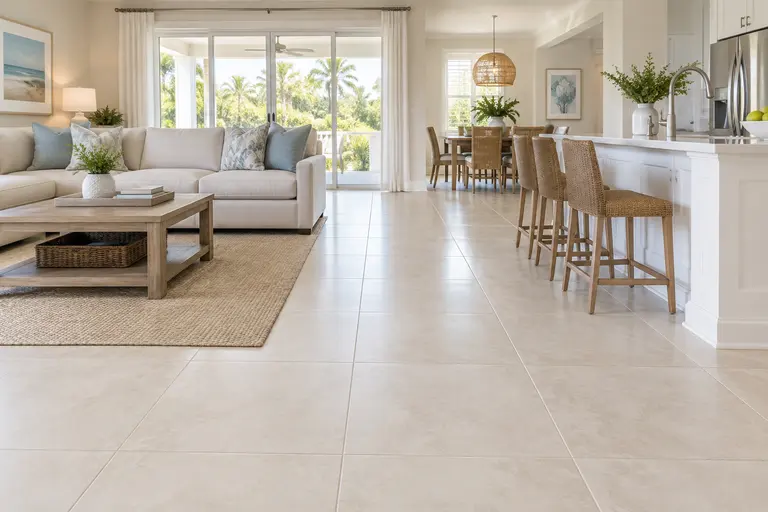
Fort Myers city water is soft, so heavy white mineral crust is a smaller worry for your grout here. The bigger problems are damp and sand. Showers stay wet long after you use them, mildew settles into the low joints, and fine grit wears darker paths across tiled floors. Below is what we look for in Fort Myers grout and which service deals with which problem.
Soft water, soap film and gray joints
Homes on city water get it from the City of Fort Myers Water Treatment Plant, which reports hardness of approximately 30 ppm or 1.8 grains as calcium carbonate. That puts the supply in the soft class. Soft water carries little calcium, so you will not see thick white crust forming in shower grout the way it does where water is hard.
Soft water has its own side effect. Soap lathers easily in it and takes longer to rinse away. The leftover soap mixes with skin oil and shampoo, dries on the grout as a thin waxy layer, and that layer catches dust. Over a year or two the joints drift from their first color to a flat gray that no spray bottle seems to move.
We clean that residue with an alkaline cleaner made for soap and body oil, worked into each joint with a stiff brush. The crew then rinses with hot water and pulls the dirty water out with an extraction tool, so the residue leaves the shower instead of settling back into the lowest grout lines.
Sealing still pays off in a soft-water home. A penetrating sealer closes the pores in cement grout, so soap film stays on the surface where a quick wipe takes it off. It also blocks hair dye, coffee and cooking oil, which stain kitchen and bath grout no matter what comes out of the tap.
Long wet seasons and shower mildew
The NOAA normals station at FT Myers Page FLD AP, FL, about 3 miles away, logs 57.4 inches of precipitation in an average year. Rain like that keeps the air moist for long stretches, and a bathroom in moist air takes a long time to dry out after each shower.
Mildew needs water and something to feed on. Grout supplies both. It holds water in its pores, and the soap residue from the section above is food. The first signs are small dark dots along the bottom row of tile, in the corners of the shower pan and under the lip of a bench. Left alone, the dots join into dark lines that follow the joints up the wall.
Bleach lightens the color for a while, but it leaves the residue the mildew grows in, so the dots come back. A full clean removes the residue and the staining together, and a sealer afterwards slows water getting back into the grout. We will not tell you a shower will stay spotless in a wet climate. We remove what is there and make it slower to return.
Between visits, run the fan during the shower and for a good while after, squeegee the walls, and leave the door or curtain open so air reaches the pan.
One more place to check is the inside corners. Where the wall meets the pan, and where two walls meet, the joint should be a flexible caulk, not grout. Grout in those corners cracks as the shower moves slightly with use, and the crack holds water that feeds mildew from behind. If the crew finds grout or split caulk in a corner, they will point it out. Replacing it is a small job that keeps the rest of the shower drier, and it is worth doing before any sealer goes on.
Sand at the door, every day
The USDA soil survey lists the top soil layer at the center of ZIP 33901 as sand, and puts the ground there in the poorly drained class. The ground at that point sits at about 10 feet of elevation. Wet, sandy soil close to the surface ends up on shoes, paws, bikes and beach bags.
Sand grains are hard. On a tile floor they roll under every step like grinding grit, and grout is the softest surface on the floor, so it wears first. Traffic lanes show it: the path from the garage door to the kitchen, the strip in front of the slider, the hallway to the bathroom. Those lines turn darker and rougher than the grout under the sofa.
Damp sand does more harm than dry sand. It brings fine silt and plant matter with it, and both soak into unsealed grout and stain it brown or gray. A deep clean pulls most of that back out. Where years of wear have left two clearly different shades on one floor, color sealing brings the whole floor back to a single even color.
A coarse mat outside each door and a soft one inside catch most of the grit. Dry-mop the main lanes a few times a week and the sand never gets the chance to be ground into the joints.
Older grout in ZIP 33901, newer grout across town
Census figures put the median year built for Fort Myers homes at 2001, across 48,984 housing units, and 36 percent of those homes are detached single-family houses. Most homes in the city are something else: condos, townhouses, apartments and other attached housing, where the tile tends to be wall to wall.
ZIP 33901 is older. Its 11,930 housing units have a median build year of 1979. Grout of that age has seen many owners and many cleaning products. Some joints have worn low, some carry hairline cracks, and some were patched with a grout that never matched.
Cleaning brings back the grout that is still sound. When joints are crumbling, hollow or missing, cleaning cannot rebuild them, and the crew will say so plainly. That work is Regrouting and Tile Repair, which we price by quote after we have seen the tile.
Newer homes have a different weak spot. Grout in a new build is usually left unsealed at handover. It looks fine for the first year, then starts holding every spill and every footprint. If your home is recent, the easiest win is sealing the grout while it is still close to its original color.
Matching the service to the tile
Tile and Grout Cleaning is the base of every visit: a pre-treatment, a brush in each joint, a hot-water rinse and extraction. It suits floors, backsplashes and counters that are dirty but structurally sound.
Grout Sealing adds a clear penetrating sealer after the clean. It holds the color you see on the day and makes later cleaning easier. Grout Color Sealing goes a step further with a tinted sealer that hides stains cleaning cannot lift, and it lets you change a dated grout shade without regrouting.
Shower and Tub Grout Cleaning works on soap residue and mildew on walls, benches, niches and pans. In a city this wet, we suggest pairing it with sealing so the clean result lasts. The grout under a glass door gets extra attention, since soap and water collect there out of sight.
Natural stone is its own case. Travertine, marble and limestone need a stone-safe method, because acid and vinegar etch the surface. We never use either on stone. Tell us the tile type when you book, and the crew will bring the right cleaner and sealer for it.