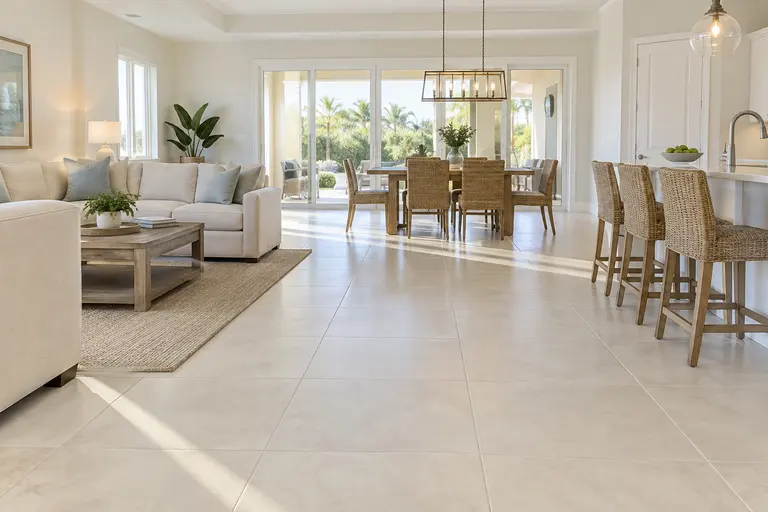
Jacksonville spreads across a huge area, from the beaches to the Westside, and almost every home in it has tile somewhere. The grout between that tile deals with sand, hard water and long humid summers. This page explains what that means for your floors and showers, and when cleaning, sealing or color sealing is the right call.
JEA water changes from one ZIP code to the next
JEA publishes hardness by ZIP code, and the spread is wide: 120 to 372 mg/L depending on ZIP code, measured as calcium carbonate. Even the low end counts as hard water, and the high end is very hard. Two houses across town can see very different scale on the same kind of tile.
Hard water carries dissolved calcium and magnesium, and every time it dries on a tile wall, a little of it stays behind. In grout, which is porous, the minerals collect below the surface and turn the joints chalky and stiff to the touch.
If you live in one of the harder ZIP codes, you will notice it first on glass shower doors and on the grout along the bottom of the walls. That white line is mineral scale, and it often hides a gray layer of soap residue underneath. A store-bought spray softens the top and leaves the rest.
The crew removes both layers with a cleaner chosen for the tile, works each joint with a brush, and rinses with extraction. Sealing afterwards is the step that makes the result last. Sealed grout no longer drinks in the mineral water, so the next deposits stay on top where a towel or squeegee can take them off.
Sand, beaches and the grout by the door
The soil survey maps fine sand as the top layer near the center of the city, with a drainage class of poorly drained. Sand in the yard means sand in the house. It rides in on shoes, beach towels, coolers and dogs, and much of it ends up in the grout lines just inside each door.
Sand is hard and sharp at a small scale. Walked across a tile floor, it grinds at the grout surface and opens it up, so the joint absorbs more dirt each week. That is why the first few feet inside a front door or a slider are often the darkest grout in the house.
Poorly drained ground also keeps yards wet after a summer storm, which adds a layer of muddy water to the sand. When that dries in the joints it leaves a brown tint that mopping spreads instead of removing. Over time the tint works deeper into unsealed grout.
A deep clean pulls the sand and soil back out of the joints. For homes near the beaches, we suggest sealing entries and the path to the back door, and keeping a coarse mat outside and a soft mat inside each door. A quick dry sweep before mopping does more for the grout than any cleaning product.
Pool decks and lanais add another source. Chlorinated water splashed onto tile dries into a crust along the grout, and screen enclosures trap leaves and pollen that stain the joints yellow and brown. The crew can clean covered outdoor tile on the same visit as the inside floors, so the whole path from the pool to the kitchen ends up one color.
Wet summers, cool snaps and the bathroom
The NOAA normals station Jackson Whitehouse Nolf, FL, about 7 miles away, records 50.8 inches of precipitation in an average year. Summer brings most of it in afternoon storms, and the air stays heavy. Bathrooms in that climate dry slowly, and slow drying is what lets mildew take hold in grout.
Winter brings cold snaps too. The same station averages 24 days a year with a low of 32 F or colder. Cold mornings mean long hot showers and closed windows, so winter bathrooms fill with steam that settles on the tile and the grout.
Mildew stains show up first in the corners of the shower, along the base of the walls and on the grout around a niche or bench. Cleaning lifts the staining from the surface. If stains return within days, or the grout feels soft, water may be getting behind the tile, and the right fix is regrouting, which we quote from your photos.
Keep the fan running for a while after showering, leave the door open, and wipe the lowest row of tile dry. Those habits keep grout drier than any spray, and they help a fresh sealer last its full life.
Houses across a big city
The Census Bureau counts 430,825 housing units in Jacksonville, and detached single-family houses make up 59 percent of them. The median year homes in Jacksonville were built is 1987. That covers older block homes with small bathroom tile, plus the large subdivisions where tile runs through the entire main floor.
Older bathrooms with small square tile have a lot of grout per square foot, and that grout sets the look of the whole room. When it is clean, the room feels bright. When it darkens, even spotless tile looks old. These rooms respond very well to a deep clean followed by color sealing.
Newer homes tend to have large porcelain tile with narrow joints across the kitchen, family room and halls. There is less grout, but every joint is visible against a plain tile face, and the traffic lanes show quickly. On those floors we often clean the whole area, then seal so the lanes stay close to the rest of the floor.
Picking the right service
Cleaning is the starting point for every job. It removes soil, sand, grease, soap film and mineral scale from the joints and the tile face. Many floors look like new after cleaning alone, and if that is all you need, it is all we do.
Clear sealing goes on after the clean, on the same visit, and keeps the grout from soaking up the next spill or the next round of hard water. It does not change the color. In a hard-water ZIP code, sealing showers is the single step that most extends the time between cleanings.
Color sealing is for grout that is sound but no longer one color, such as a kitchen with dark lanes or a bathroom where the lowest joints are stained by minerals. A tinted sealant goes into every joint by hand and gives the floor an even shade. Regrouting and tile repair are for joints and tiles that are cracked, loose or missing, and we price those from photos.
If you are not sure which of these you need, pick the closest one in the quote form and add a note or photo. The crew checks the grout before starting and tells you if a different service would work better.